
Sub Videos
To appropriately merge video instruction (student or teacher produced) within the context of an inquiry cycle, you must first ask yourself the question: what is the purpose of a video? Personally, I feel video is best used as a supplementary tool, on the BACK END of a learning cycle to deliver additional tools to students. I enjoy using videos for this purpose, as those tools and skills that are best delivered via video, in my opinion, tend to be lower-level, and thus easily forgotten. The “ah ha!” moment that makes inquiry so beautiful is something that a video struggles to capture but a student will never forget. The tools needed (equations, examples, etc) to apply that “ah ha!” moment in a different context, especially in an advanced class, such as AP Chemistry, are often forgotten, and should be cataloged. Hence, video…
So why is this post titled “Sub Videos”? When I first began merging tablet and screencasting technologiesto create instructional video, one of my favorite applications was for sub assignments. I would simply record myself modeling a few problems for students…have the sub play those videos…have the students solve some related problems…have the sub play solutions to those videos, etc. It worked like a charm (at least I thought…). See example video below:
Despite initial “success”, after presenting at CUE in Palm Springs last month, something struck me. I was in the middle of my standard discussion about Blooms Taxonomy, and how the true “flip” does not involve homework with lecture, but intentionally matches the “community” (classroom) with learning activities appropriate for the community (higher end Blooms). Conversely, matching the “individual” (outside of class time) with learning activities appropriate for that space (lower end Blooms). See image below:
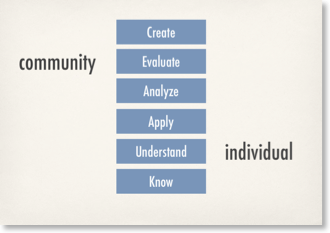
While giving that presentation, I realized that my students were back in San Francisco, with a substitute, watching videos IN THEIR COMMUNITY SPACE (classroom) of me solving problems as I would IN THEIR INDIVIDUAL SPACE! Because my students were all together, I was missing an opportunity to use video as an inquiry tool, and instead, using it as I normally would on the back end of an inquiry cycle, as a tool delivery medium. So, the last few times I have missed class since CUE (happens often given the arrival of my second child!), I have been experimenting with using video in a way that values the community, promotes inquiry, and models how I normally would carry out class if I was there. Rather than solve problems, I have been presenting open ended scenarios for students, and given a set of prompting questions, instructing the sub to have students discuss possible solutions to the scenario. Often, I have coupled the situation with follow up videos that provide further explanation, but NOT UNTIL the initial inquiry scenario is presented. Below are a few examples:
Pre Video Question*: Does Bromothymol change color in an acidic or basic environment? Justify by writing a chemical reaction to describe the process.*
Pre Video Question*: Can you explain this observation using what you know about ideal gas behavior?*
Archived post, preserved from the Wayback Machine for the record.
Related reading
Simulating Parkinson's: Using Electronics to Build Empathy
This lab activity takes students on a unique journey through the world of neuroscience and engineering to explore the complex nature of Parkinson's Disease. Students will simulate the motor...
Read →Exploring Fentanyl's Risks: Using Chemistry to Imitate the Brain's Protective Layer
This lab activity directly tackles a pressing issue: the opioid crisis, with a spotlight on fentanyl, one of the most potent and problematic drugs out there. This isn't just any experiment; it's a...
Read →Fast AI Game Design Using ChatGPT and p5.js
Experimenting with leveraging ChatGPT as a medium for generating code to run simple JavaScript games in p5.js . My ultimate goal is to create a system where students can use both applications to...
Read →