
Stoichiometry as a Board Game
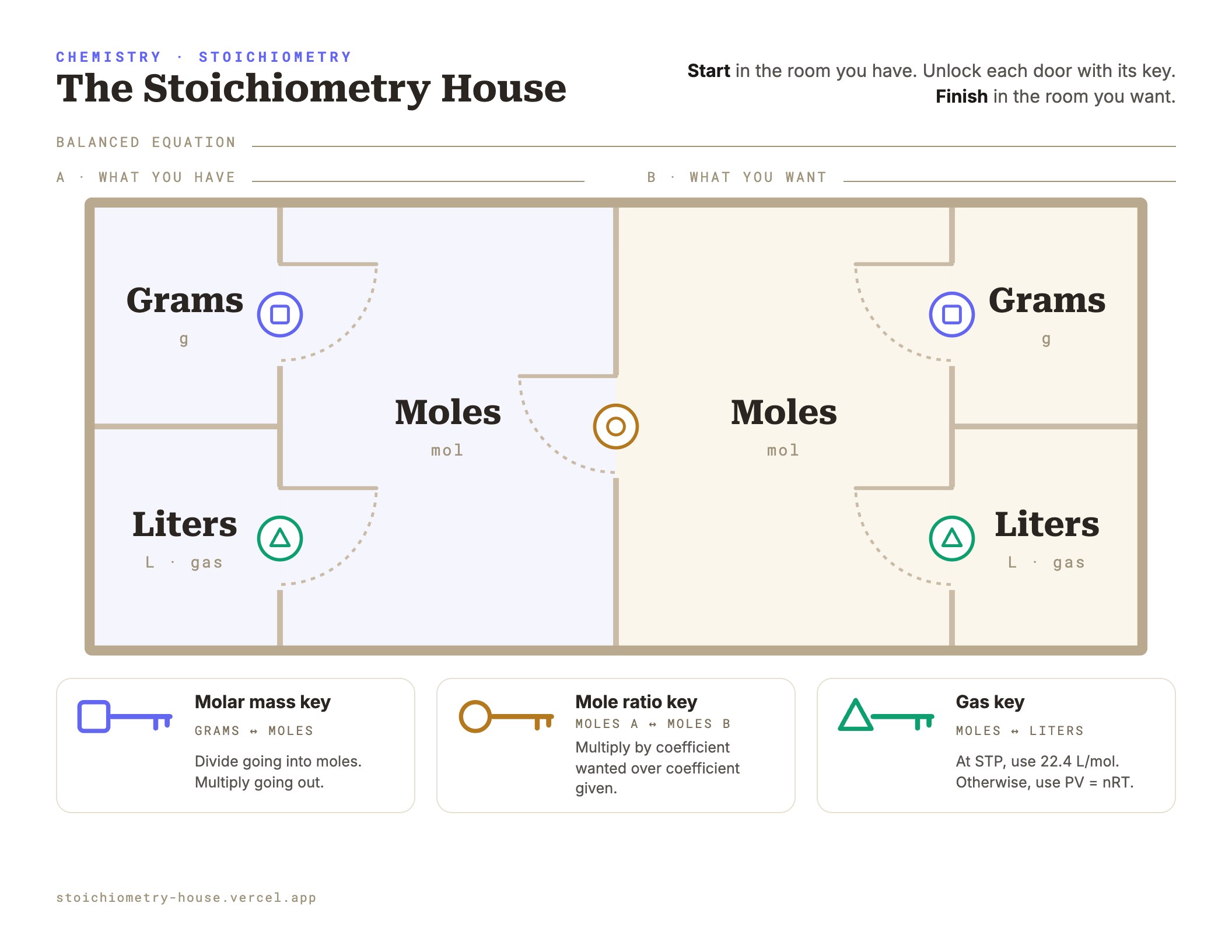 The Stoichiometry House. One page. Students solve on it and play on it.
Stoichiometry is one of those topics that quietly decides how a lot of first-year chemistry students feel about chemistry. Get through it and the rest of the year opens up. Get stuck and it becomes the moment a kid decides they are "not a chem person." I have been teaching it for a long time, and I am still looking for better ways in. This year I finally built something I have wanted to make for years: a board game.
Where I'm coming from
For most of my career I taught stoichiometry with an ICE table (some years I called it BCA): what you have before the reaction, how it changes, and what you end with. It lives in my old 5E / Hero's Journey stoichiometry lesson, where students hunt for the best Alka-Seltzer and water combination before we formalize anything. I even made helper videos for it, like the one below.
My old ICE helper video. There is a BCA version too.
I LOVED what the ICE table modeled. Limiting and excess reactants stop being a trick and become something you can see. One reactant runs out, the other has some left over, and the table shows it happening in real time. As a conceptual model it is hard to beat.
What kept bugging me
Over time, though, a few things kept nagging at me. The table leaned hard on the algorithm. Students got good at filling in boxes, and I was never totally sure they knew why they were doing it. I chewed on this a few months ago in Making the Lesson, Not Planning It, the gap between algorithmic knowledge and conceptual knowledge. A student can run the routine correctly and still not know what a mole is.
It was also hard to deploy right away. The table takes real setup before kids can use it on their own, so there is a long stretch of me at the board before the thinking becomes theirs. And the simple stuff, the everyday grams to moles conversions, lived off to the side instead of inside the same picture as the reaction math. Students treated them as two separate skills, when really they are one path.
So I started asking a different question. What if the whole thing was a place you could walk through?
The house
That question turned into The Stoichiometry House. Six rooms: Grams, Moles, and Liters for the substance you have, and the same three for the substance you want. Five doors connect them, and each door uses one of three key types.
- Molar mass key (indigo square): Grams to Moles and back.
- Mole ratio key (amber circle): the hallway between the two substances.
- Gas key (green triangle): Moles to Liters, using 22.4 L/mol at STP or PV = nRT.
The rules under the house are: into Moles, divide. Out of Moles, multiply. Across the hallway, multiply by the mole ratio. That's it. Every problem becomes a route. Start in the room you have, unlock each door with its key, finish in the room you want. Mole to gram conversions and reaction stoichiometry finally live in the same picture, because they are literally the same trip, just longer or shorter.
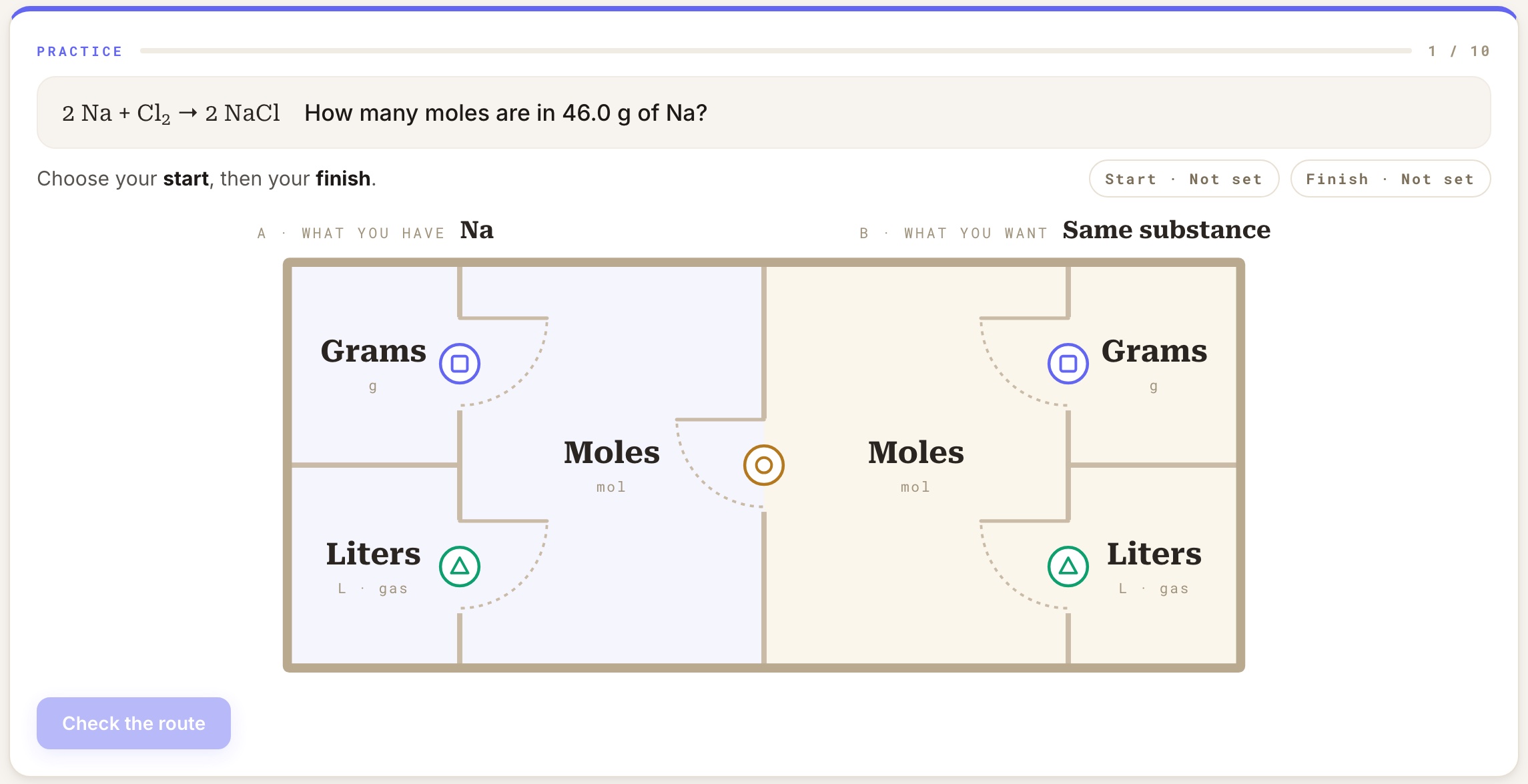 Practice mode. Students pick the start and finish rooms first, then check the route before touching any numbers.
How to play
The sheet is the board. Two to four players, a token each (a coin, a cap, an eraser), and a deck of Problem cards and Key cards. The full kit is one printable PDF, and the house sheet alone is a single page.
- Read. Flip a Problem card and read it out loud. Put your token in the start room and point to the finish room.
- Unlock. For each door on your route, play the matching Key card and move through. No matching key? Your token waits at that door until next turn.
- Score. Reach the finish room and keep the card. It is worth one point per door you passed through.
- Refill your hand to three Key cards. First to 7 points wins.
The deck also includes a Master key. It opens any door, as long as you say which key it is standing in for.
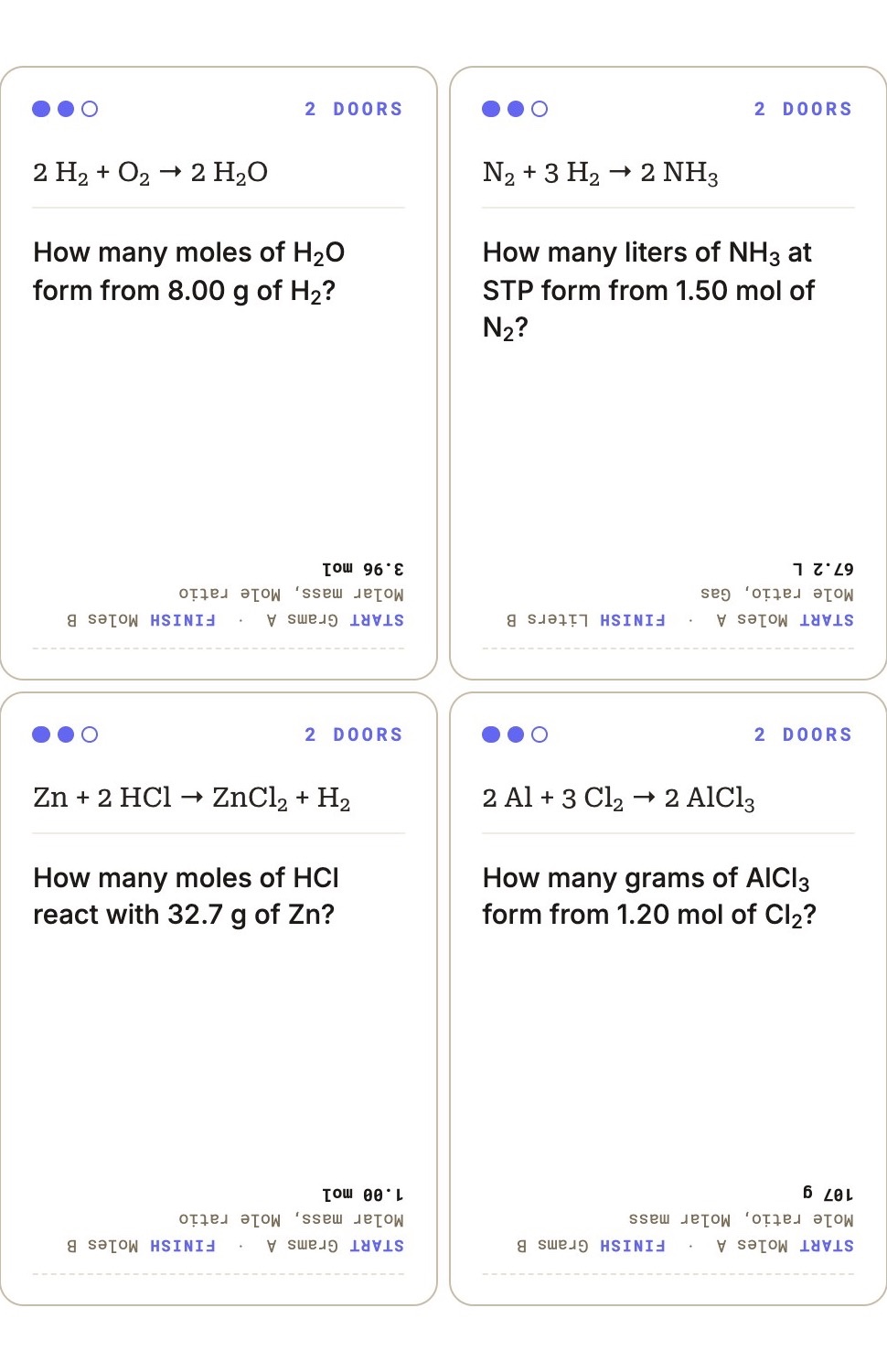 Problem cards. Flip one upside down to check the route and the answer.
There are three levels, and this is the part I am most excited about. Level 1 is just Rooms: name the rooms and keys, no numbers. Level 2 is Moves: as you play a key, say what it does ("Molar mass key: 46.0 g divided by 22.99 g/mol"). Level 3 is Solve: between turns, work the problem in your notebook and match the answer on the card for a bonus point. Same board, and the math shows up only when the route already makes sense.
There is also an online version for when paper is not an option. You draw a key and call it right or wrong before the game reveals the result. A correct right-key call moves you one room, a correct wrong-key call keeps you put, and an incorrect call costs one point. Reach the finish, then solve the problem to claim its door points.
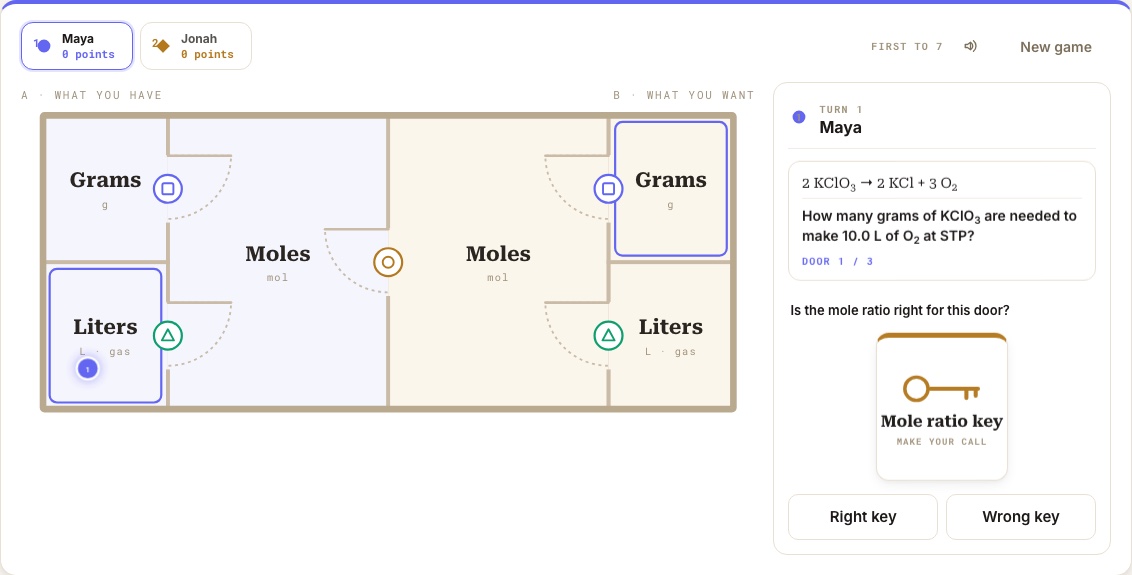 The online version. The route lights up. Each key appears before you call whether it fits.
Still figuring it out
I don't think the ICE table was wrong. It taught a lot of kids to see limiting reactants, and the house doesn't do that part yet. I might bring the table back once students have the house down. What I am after is the order. Route first, then moves, then math. Let students walk the path before they have to calculate it.
Is it better? I honestly don't know yet. That's the fun part. If you teach chemistry and give it a try, grab the house sheet, play a round, and tell me what breaks. I would love to hear it :)
Related reading
Movies, Clips, Curiosity, Spark, Videos
My 15 Favorite Movie Clips to Use as Science Curiosity Sparks, Strategically leveraging clips from movies that show various phenomena. Read more: Cycles of Learning.
Read →Curiosity, Technology, Chemistry
Most powerful ways to spark Involuntary Curiosity in students is to strategically trim a video clip to remove content or present an unresolved of the content.
Read →EdTech Team Hangout on Blended Learning
CYCLES OF LEARNING
Read →