
Word Clouds
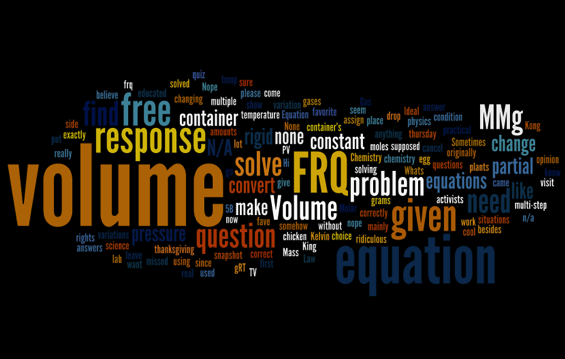
For the past few years I have been experimenting with word clouds, specifically using Wordle, and more recently, Word Sift. Traditionally I have only used them to create clouds of student questions that they report via a google form after completing any readings, watching videos, etc., outside of the classroom. I copy their responses from the spreadsheet into Wordle and have the cloud displayed as they walk in. The visual provides a nice starting place, and allows all of us to SEE misconceptions and questions, rather than me having to dig them out. The below screenshot is a cloud created after a lesson on ideal gas behavior. It is obvious from the cloud that students struggled with various aspects of “volume” in particular the “free response” or “FRQ” question that followed the lesson. Students seem curious about the what the cloud means, and at the most, I think it promotes more critical thinking around what they just learned. At the least, it provides a cute way to segway from misconceptions and questions, to content application. Not a bad thing.
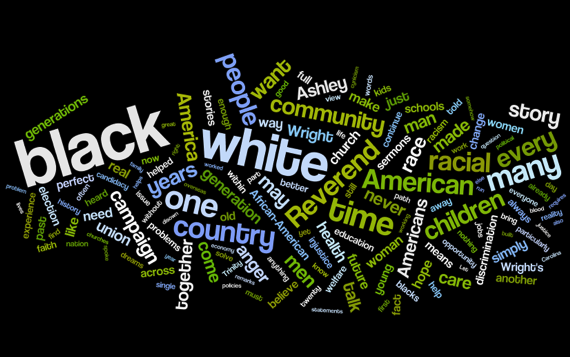
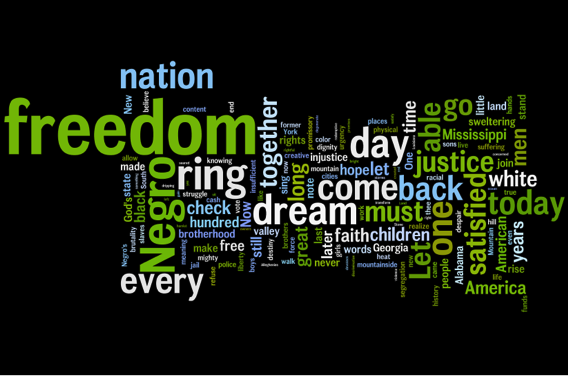
In conversation with a colleague who is a history teacher, we started brainstorming ways of integrating Wordle into his classroom in a more critical, exploratory fashion. We tossed around the idea of taking speeches from history that, although separated by time, represent a similar mind-set or message, copying the text into Wordle, and having students analyze the clouds for similarities and differences. Or even better, providing the clouds first, and asking students if they can predict the speech or event that the cloud was derived from. Below are two clouds. One from Martin Luther Kings’ I Have a Dream Speech and the other from Barack Obama’sA More Perfect Union speech on race. Can you match each cloud with its Author? Notice an similarities? Differences?
Related reading
Simulating Parkinson's: Using Electronics to Build Empathy
This lab activity takes students on a unique journey through the world of neuroscience and engineering to explore the complex nature of Parkinson's Disease. Students will simulate the motor...
Read →Exploring Fentanyl's Risks: Using Chemistry to Imitate the Brain's Protective Layer
This lab activity directly tackles a pressing issue: the opioid crisis, with a spotlight on fentanyl, one of the most potent and problematic drugs out there. This isn't just any experiment; it's a...
Read →Robotics for Social Good: 'Bomb Squad' Simulation
Robotics for Social Good: 'Bomb Squad' Simulation
Read →