
SBG and Evernote
Last fall I began implementing a simplistic version of Standards Based Grading (SBG) in our chemistry class. Click here to read more. In this version, students are encouraged to reassess frequently given the following three conditions 1) reassessment must occur at least 24 hours after meeting with me for a re-teaching episode if needed, 2) reassessment must be scheduled using this form, and 3) reassessment questions, targeted to specific standards, will always be more rigorous than the previous question(s). Anecdotal evidence has shown that this accounts for the covariate of time fairly well. At least I think :)
Because reassessment questions are “standards based” they are very targeted and usually involve only one or two questions. To manage this process, I simply write a question on a notecard and then ask the students to solve the question on a whiteboard in front of me in class. Below is a picture:
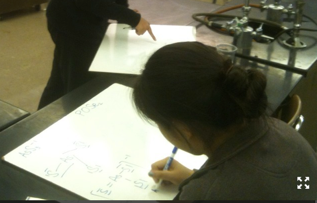
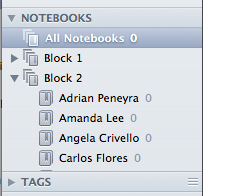
This process has worked very well. However, given the number of students reassessing, and the lack of a paper copy of the reassessment, tracking the process has been difficult. Moreover, although reassessments are summative in their performance on a specific standard, because students can reassess continuously throughout the year, their answers also provide a lot of formative information that is not cataloged in this system. Introduce Evernote!Last week we received our class schedules, and during our youth STEM camp, I had some of my high school helpers make an Evernote “stack” for each of my “blocks” (class periods) and then make a separated Evernote folder in the appropriate stack for each student. Below is a screenshot:
Because my iPhone/iPad has an Evenote app, after each reassessment, I plan on making a note in each students file that includes a picture of their whiteboard, and a quick audio interview about how they felt, areas of improvement, growth, etc. Below is a screenshot of the note interface:

I will then share this folder with the students (maybe even parents) and thus build a formative library to not only track progress, but also help students build metacognition (“thinking about thinking). Not sure how this will go, but I am very excited to begin the process!
Archived post, preserved from the Wayback Machine for the record.
Related reading
Simulating Parkinson's: Using Electronics to Build Empathy
This lab activity takes students on a unique journey through the world of neuroscience and engineering to explore the complex nature of Parkinson's Disease. Students will simulate the motor...
Read →Exploring Fentanyl's Risks: Using Chemistry to Imitate the Brain's Protective Layer
This lab activity directly tackles a pressing issue: the opioid crisis, with a spotlight on fentanyl, one of the most potent and problematic drugs out there. This isn't just any experiment; it's a...
Read →Robotics for Social Good: 'Bomb Squad' Simulation
Robotics for Social Good: 'Bomb Squad' Simulation
Read →