Student Blogging
Experimenting this year with very organized student blogging. With respect to assessment, at the conclusion of every learning cycle students take a quiz and then produce a "cycle blog" where they discuss what they did during that cycle include pictures and videos of their activities and reflect on what they understood and didn't understand on both summative and formative assessments.
This blog will take the place of any formal lab reporting (except in AP chemistry where students will still be required to produce lab reportsa) and also will take the place of formally checking off homework as students will be required to reflect on their learning.required to reflect on their learning. Thus, with respect to summative assessments, the year will be filled with rotations of quiz then blog, quiz then blog, quiz then blog. I really struggle with assessment, and I'm hopeful that the structure will both make grading more organized and meaningful for students, and help me keep track of what students are lacking with respect to skills and reflection.
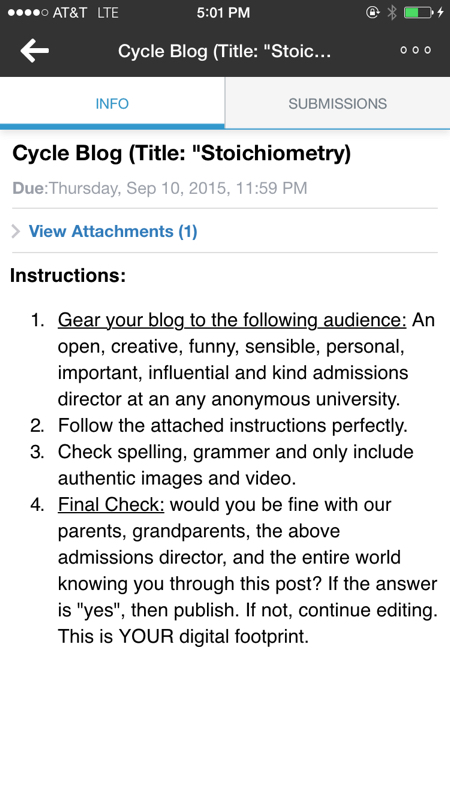
Below is a screenshot of the instruction students received tonight as they work on their first blog post of the year.
Keep reading
New writing, when there is something worth sharing.
Notes on curiosity, inquiry, science teaching, and building the lesson.
No spam. Unsubscribe anytime. Prefer RSS?
Related reading
Google Slides Lab Report: A Simple, Tangible, Reasonable Solution
Google Slides Lab| I have written in the past about my transition from formal lab reporting to the use of Google Slides as a student form of reporting lab work.
Read →How to 'ClassSource” a Simple, Meaningful, and USEFUL Review Document
Before every major assessment I like to facilitate review activities in class. That being said, I can only handle the Kahoot theme song so much Cycles of Learning
Read →Student Chomps
To prepare for our upcoming exam on gases, students worked in groups to make instructional videos using screenchomp . Below are the steps I used to facilitate the process: Step 1: Each group...
Read →