
How to 'ClassSource” a Simple, Meaningful, and USEFUL Review Document
Before every major assessment I like to facilitate review activities in class. That being said, I can only handle the Kahoot theme song so much, play so many games of "Chemistry Jeopardy", or figure out another variation of Periodic Table Battleship to satisfy review of the whatever skills we are learning that topic.
Not that there is anything wrong with the above games, or the myriad of variations. Indeed, if I played Kahoot everyday my students would be STOKED!
However, the above review games, in my mind, always fall short in one area: student creation/invention.
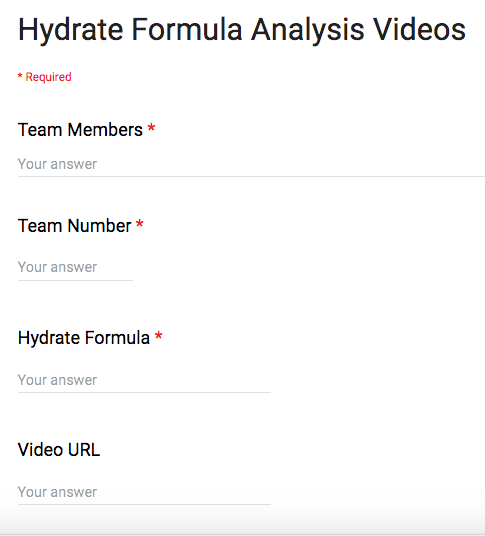
This is where Google Forms is a powerful tool! During the past unit on Formula Analysis, distributed a different problem to each team of students.
I then asked each team to submit its solution and a video explaining the problem on a whiteboard through a Google Form.
I shared the response sheet only inside the class workspace, and students spent time solving one another's problems and watching the explanations when they were stuck.
Although not as superficially engaging as Kahoot, watching students invent videos to explain their problems, and negotiate not only the problem, but also how to teach it, was incredibly inspiring, and IMO, much more engaging from an outside perspective.
Although this is a simple application of Google Forms, the power came from immediately returning the class-created question bank to the learners while keeping the recordings private. The form itself only needs fields for team, assigned problem, written solution, and a permission-controlled video URL.
Keep reading
New writing, when there is something worth sharing.
Notes on curiosity, inquiry, science teaching, and building the lesson.
No spam. Unsubscribe anytime. Prefer RSS?
Related reading
Google Slides Lab Report: A Simple, Tangible, Reasonable Solution
Google Slides Lab| I have written in the past about my transition from formal lab reporting to the use of Google Slides as a student form of reporting lab work.
Read →Mass Group Google Doc Editing During Class
CYCLES OF LEARNING
Read →Authentic Audiences: Moving Beyond the Blog Post
Like many teachers, I have always struggled with making assessment meaningful for students. After reading Show Your Work by Austin Kleon I moved from student Google Doc lab reports in chemistry class.
Read →