
Lower Blooms Basketball
The model below is a simple look at how I strive to pair the cognitive rigor of the learning task (higher or lower blooms) with the learning environment (individual or community space). I firmly believe that the classroom space should be a realm of critical thought and inquiry, while the individual space should be reserved for more algorithmic skills, less suited for a community of learners.
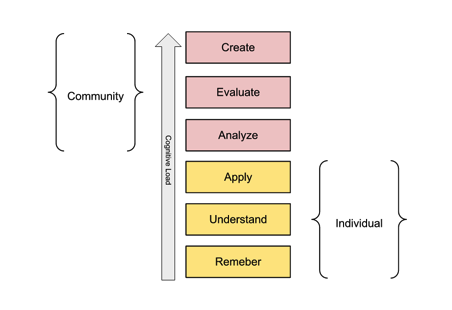
However, “drill and kill” activities that promote assimilation of content do have their place in the classroom and can often provide a great opportunity for entertaining review activities that can help build community. When these assimilation activities are placed after the inquiry and accommodation process, their purpose is more evident and their application more relevant. This week I introduced a game called “Lower Blooms Basketball” as a way to promote assimilation. We are in the process of studying chemical equilibrium, and the ability to predict which direction an equilibrium will shift when a stress is applied (Le Chatelier’s Principle) is a skill whose solution comes quickly, but one that requires a lot of practice.
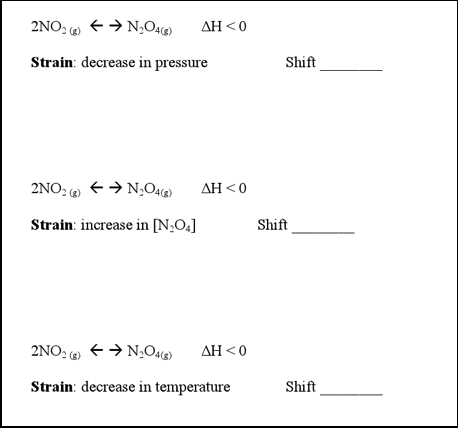
To do this, I created a sheet of ~ 25 different, quick problems, and then made ~ 100 copies. I the cut the problems into little slips, placed them in bins and distributed them throughout the classroom. These were the “basketballs”. Below is a screenshot of one sheet:
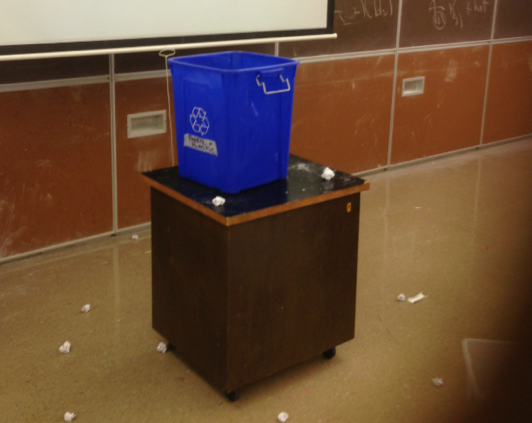
Using duct tape, I placed a “three point” from one end of my classroom to the other, and placed a garbage bin in front of the classroom as the “hoop”. The rules of the game are as follows:
- Grab a problem, write your name on it, and solve the problem.
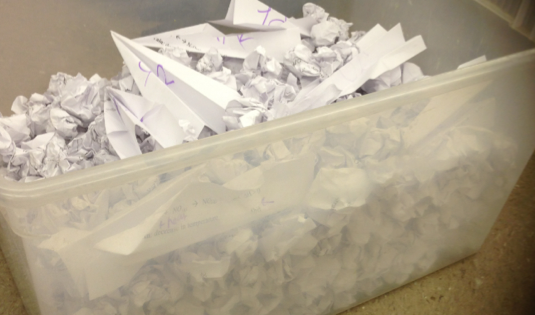
- Crumple it up and shoot it in the hoop.
- For every problem you make in the hoop, correct, you get 1/10 of an extra credit point.
- You can shoot as many times as you want, but each shot must be a new problem.
- I will be roaming and shot blocking :)
By the end of the 30 minutes, students had solved about 50 problems on average, with some completing far more. The next day, I gave a pop quiz built from the toughest Le Chatelier problems I could find, most involving pressure and temperature changes. Student performance was incredible. Although this task promoted rote, "drill and kill" learning, assimilating the concept after students battled their misconceptions in the laboratory proved to be a meaningful use of class time.
Keep reading
New writing, when there is something worth sharing.
Notes on curiosity, inquiry, science teaching, and building the lesson.
No spam. Unsubscribe anytime. Prefer RSS?
Related reading
Stoichiometry as a Board Game
For years I taught stoichiometry with ICE tables. I still love what they model, but this year I tried something different: a one-page house that is both the solving sheet and the game board.
Read →Booms Taxonomy 'Walk Around' Inquiry Model
Describing a model for inquiry lesson planning that incorporates Bloom's Taxonomy and Depth of Knowledge.
Read →Daily Online Teaching Cycle Model
Online teaching model used during the COVID-19 pandemic with links and examples. Professional development opportunities.
Read →