
Importance of a Reflection Mechanism
have written often about how including a google form to track student qualitative and quantitative reflection of instructional videos has made all the difference in my class. The below video provides an example of this process (note: there is a numerical mistake in the example problem shown and I no longer encourage students to chunk the video up into parts while providing the summary. I have found that asking students to reflect upon entire video encourages more synthesis and critical analysis):
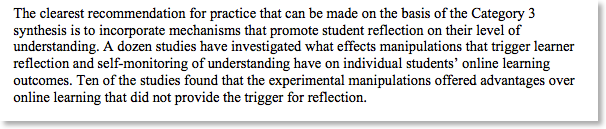
Recently I stumbled upon a research Meta-Analysis and Review of Online Learning Strategies provided by the U.S. Department of Education that validates this reflection mechanism. Below is a screenshot taken from the report:
Recently I stumbled upon a research Meta-Analysis and Review of Online Learning Strategies provided by the U.S. Department of Education that validates this reflection mechanism. Below is a screenshot taken from the report:
Keep reading
New writing, when there is something worth sharing.
Notes on curiosity, inquiry, science teaching, and building the lesson.
No spam. Unsubscribe anytime. Prefer RSS?
Related reading
Escape Room Lab
I wanted a classroom escape room builder that was free, content-first, and took about ten minutes to use. I could not find one, so I built Escape Room Lab. Here is how it works and how to use it with your own students.
Read →Stoichiometry as a Board Game
For years I taught stoichiometry with ICE tables. I still love what they model, but this year I tried something different: a one-page house that is both the solving sheet and the game board.
Read →Build the Tool, Don't Find the Tool
A classroom question about blinking became a purpose-built data tool and a case for building the app a lesson needs.
Read →