
Facial Reconstruction Simulation using Fusion360 and Blender
An Ear, Nose, and Throat surgeon visited our engineering class to describe reconstructive work with bear-mauling patients in Alaska. The medical team used 3D reconstructions from pre-injury images to fabricate custom supports for damaged bone and tissue. This overview provides additional context for the intervention.
3D modeling has been a major theme in our class, and students were immediately drawn to the use of CAD in solving meaningful problems. Inspired by the presentation, I replaced the planned unit with a simulation of the process described by our speaker. After experimenting with Fusion 360 and Blender, I built the instructional sequence below.
Step 1: Students downloaded and learned how to use the FaceBuilder add-on in Blender which allows for the reconstruction of 3D model of a face given images. This is essential keeping in mind the triage nature of the injuries addressed using this technology. That is, previous scans may not be available and accurate reconstruction from past images is needed. See instructional video below.
Step 2: Students then hypothesized an injury to the face, such as a dog bite or the removal of a cancerous lesion, and recreated that injury using sculpting tools in Blender.
Step 3: Students exported Blender models with hypothetical injury as STL files and important the files into Fusion 360. Once in Fusion 360, students. created and extruded surfaces to serve as. customized replacements for regions where injury occurred. These customized surfaces could potentially serve as graft templates, bone reinforcement, etc. See a few images below. Click here for a surfacing tutorial.
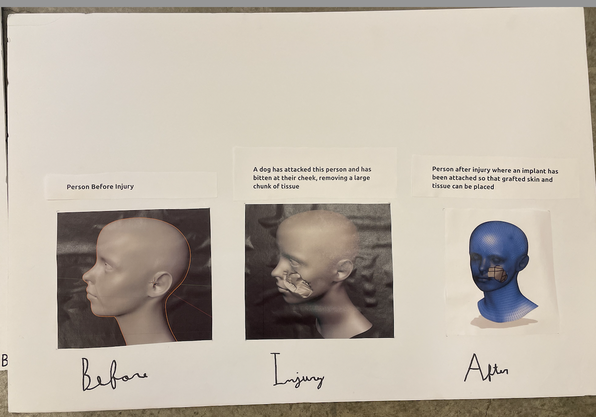
Step 4: Students 3D printed the simulated injury and the associated custom support. Teams circulated, tested compatibility, suggested revisions, and presented the process to the guest speaker for feedback about viability.
Keep reading
New writing, when there is something worth sharing.
Notes on curiosity, inquiry, science teaching, and building the lesson.
No spam. Unsubscribe anytime. Prefer RSS?
Related reading
Robotics for Social Good: 'Bomb Squad' Simulation
Robotics for Social Good: 'Bomb Squad' Simulation
Read →Microscope Phone Adaptors: A Cross-Disciplinary Project
A cross-disciplinary CAD practical connecting engineering design, microscopy, and iterative testing.
Read →From Flame Tests to Lasers: Extending Inquiry in Atomic Structure
Every year I begin chemistry with the flame test lab. It is a simple and colorful way for students to wonder about electrons. They see different salts burn with different colors, and they start...
Read →