Hacking the GradeBook Comment
Spring semester grades are due tomorrow. Along with a grade (A, B, C, D, F) we must provide a comment for each student. Comments should provide students and parents with useful qualitative information, but a high-volume reporting system creates pressure toward either overly long narratives or generic stock language.
Frustrated with the cognitive dissonance that exists in spending the entire year committed to motivating students to ask questions, negotiate complexity and develop a love for the inquiry process, while simultaneously being required to judge my students with one letter and a one paragraph comment, I decided to "hack" the system a bit. In lieu of providing one comment for each student, I wrote one letter to all of my students, and then provided a link to the letter in the comment box. See screenshot below:
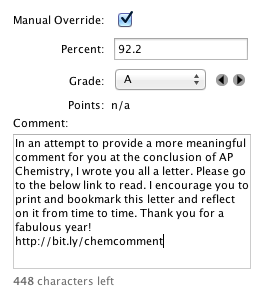
Although each student will receive the same letter, I was able to take the time necessary to clearly write a reflection that used chemistry as a window to impart a few words of advice as their journey continues. In an ideal world, and hopefully in years to come, I will be able to write a tailored letter for each student, in the context of our current system, I feel this letter is a good start. The letter is embedded below for you to read. In addition to the below letter, I had direct conversations with students and parents that needed a more personal touch, both positive and negative. I am hopeful that this combination of a grade, thoughtful letter, and individual conversations, will add more meaning to a process that often inhibits meaningful learning in my classroom practice.
Keep reading
New writing, when there is something worth sharing.
Notes on curiosity, inquiry, science teaching, and building the lesson.
No spam. Unsubscribe anytime. Prefer RSS?
Related reading
Grounding AI in Their Own Handwriting
A metacognitive end-of-year chemistry portfolio built with NotebookLM and Gemini, where the AI can only synthesize what the student actually learned.
Read →Simple Metacognitive Assessment Hack During Distance Learning
Using meta-reflections to authentic, meaningful responses to assessment questions during distance learning.
Read →Assessment and Online Teaching
Reflections on assessment in the online teaching and learning environment.
Read →