
5-in-5: Attempt at an MC Hack
I hate multiple choice questions. Not really sure why I do, as I know a lot of rich critical thinking can be done by negotiating through, creating and identifying distractors in multiple choice questions. Also, as an AP Chemistry teacher, my students have to take a 75 question multiple choice test in 90 minutes. However, I just can’t get myself to give multiple choice assessments. I think, as a fan of standards based grading, I love the ability to grade a question that targets a specific standard using a scale of proficiency, rather than “yes” or “no”.
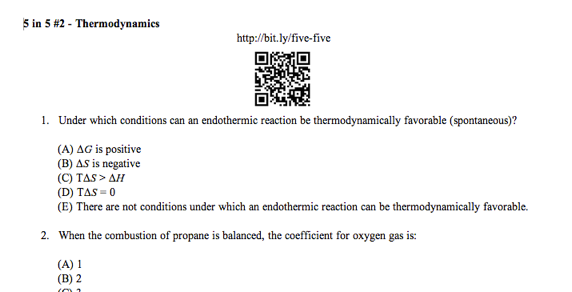
In an attempt to not run from the need to improve my pedagogy, prepare students for multiple choice questions, but also use multiple choice as more of a formative tool rather than summative, I am experimenting with something called a daily “5-in-5”. To do this, I create a daily set up multiple choice questions, and allow 5 minutes for the students to solve the problems. Students are not graded on the quizzes, but upon completing we immediately grade them together, and students enter their score (1-5) into the same form each time using a shortened URL and a QR code that is located on the top of the quiz. See screenshot below:
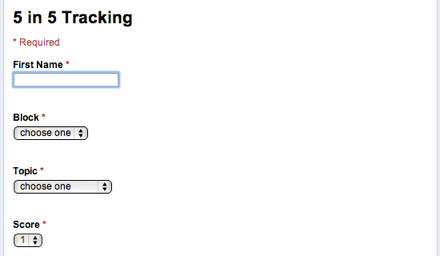
When students complete the form, they choose the topic and indicate the “block” (period) of class they are in. This data is then filtered using a pivot table so it is organized by topic and block with respect to number of correct answers. See screenshots below:
To create a “scoreboard” across blocks, I copied the above pivot table to another sheet in the same spreadsheet, and altered the output so that only block and average score across all “5-in-5’s” is displayed. Using the chart gadget, I created a bar graph from this pivot table that will dynamically update once score are added by students. See screenshot below:
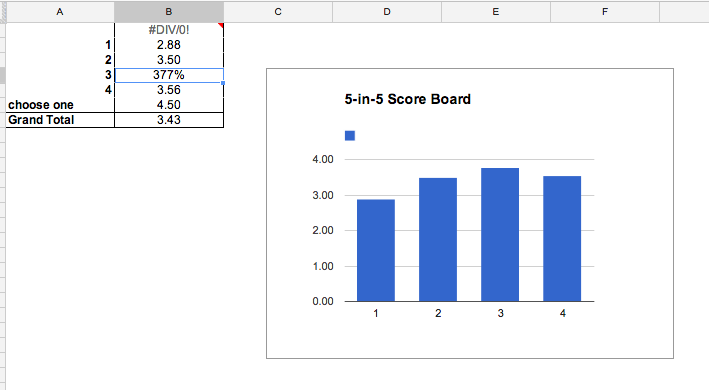
This was a lot of work upfront, but now, I simply coy the same URL and QR code to the top of each “5-in-5” and it feeds this system. I made the sub-sheet that that displays the chart public via our class website for our students to monitor, established some cheesy goals like: “Block with the highest score at the end of the week gets…”, and send out a daily updated about the scores. Without entering a single grade, it’s been amazing to see the way this simple, yet visual, rewards/accountability system has motivated students to engage in multiple choice items. Students want to do the “5-in-5”s, not because they want to improve their grade, but because they want to see if they can improve their score from the last one, and if they can contribute to the overall class score, two things I feel create a positive culture in my class, from block-to-block.
Moreover, having time set for multiple choice testing in a fashion that is void of the stress of getting “tricked” or misreading a problem, we as a class have intentional discussions about test construction and item analysis. Conversations like “Which one is the best distractor”? emerge, and help students think about the process through the eyes of a test writer, rather than a stressed out students. Next week I am going to experiment with having the students choose two answers, one for the correct response and one for the most obvious distractor, and report the “5-in-5” score accordingly. Either way, I think it is 5 minutes well spent, and I am excited to see how my students embrace the multiple choice portion of the AP test after preparing this way, rather than via the 30 questions that wold normally precede the short answer section of a boring unit exam.
Archived post, preserved from the Wayback Machine for the record.